
+86-21-34622842(REP.) +86-21-34622015(REP.)
- All
- Product Name
- Product Keyword
- Product Model
- Product Summary
- Product Description
- Multi Field Search
Views: 0 Author: Site Editor Publish Time: 2026-07-25 Origin: Site
Acquiring advanced aesthetic technology requires significant capital expenditure. Unexpected clinical downtime carries a severe financial impact for any practice. Gradual performance degradation often goes unnoticed by operators until clinical outcomes are compromised or catastrophic hardware failure occurs. Micro-fluctuations in pulse duration, energy drop-offs, or beam profile irregularities can slowly erode treatment efficacy over time.
A rigorous, documented preventative maintenance protocol is non-negotiable. Implementing a structured checklist provides a strategic framework to maximize return on investment. It ensures consistent patient safety and extends the lifespan of the device. By addressing cooling, calibration, optics, and handpiece care, clinics can maintain peak operational standards. You must treat these devices as precision optical instruments. Neglecting basic daily care leads directly to expensive repairs and unhappy patients.
Consistent daily inspection of optics and handpieces prevents debris burn-in, which is the leading cause of premature component failure.
Thermal management is critical; neglecting cooling system maintenance directly impacts the stability of ultra-short pulse durations.
Routine energy output calibration is required to compensate for natural flashlamp aging and optical degradation.
Evaluating and securing a reliable service contract (OEM or certified ISO) significantly reduces long-term operational expenses compared to ad-hoc emergency repairs.
Canceled appointments due to equipment failure damage clinic reputation and revenue. Emergency technician dispatch fees add unnecessary financial strain. Preventative maintenance functions as a predictable operational expense rather than a sunk cost. Routine care minimizes the risk of sudden breakdowns. It keeps your schedule intact and ensures patients receive timely treatments. When a system goes down mid-treatment, you lose that specific booking and risk losing the patient entirely. Scheduled maintenance allows you to control when the machine is offline. You can block out specific hours for a technician visit without disrupting your core operating hours. This proactive approach stabilizes your cash flow and eliminates the panic of unexpected hardware failures.
Compromised optics or cooling issues alter the photomechanical efficacy of a picosecond laser. Inconsistent energy delivery introduces severe clinical risks. Patients may experience paradoxical hyperpigmentation, incomplete tattoo clearance, or unintended epidermal damage. Maintaining hardware integrity is directly tied to achieving safe, predictable clinical endpoints. If the beam profile degrades from a uniform top-hat shape into a profile with intense hot spots, the risk of pinpoint bleeding and scarring increases exponentially. You cannot rely on the machine's digital display if the physical optics are dirty or damaged. The screen might say you are delivering a specific fluence, but a pitted lens will scatter that energy, leading to sub-therapeutic results and frustrated patients.
The articulated arm requires regular inspection for tension loss, misalignment, or physical damage. A misaligned arm degrades beam quality before it reaches the patient. You must check the counterweights and joints daily. If the arm drifts or feels stiff, the internal mirrors may fall out of alignment.
Test the articulated arm joints for smooth, fluid movement across the entire range of motion.
Verify proper counterweight tension; the arm should hold its position without drifting downward.
Inspect the exterior of the handpiece for hairline cracks, dents, or physical wear from daily handling.
Examine internal electrical contact pins and optical alignment keys to prevent electrical arcing during operation.
Wipe down the exterior using manufacturer-approved disinfectants, strictly avoiding liquid ingress into the optical cavity.
Protective windows shield expensive internal optics from debris. Define strict pulse-count thresholds for inspecting and replacing these windows. Verifying their condition at specific pulse milestones prevents permanent lens pitting. Visually inspect lenses for pitting, dust, or micro-fractures. Use proper magnification and side-illumination to detect microscopic flaws that scatter the laser beam. A standard protocol involves checking the protective window after every tattoo removal session, as the acoustic wave generates significant tissue splatter. If you see a speck of carbon or dust on the window, replace it immediately. Firing the laser through a dirty window bakes the debris into the glass, destroying the anti-reflective coating and requiring a much more expensive lens replacement.
Aerosolized skin particles, carbon dust, plume debris, and operator skin oils pose significant hazards. Debris on a lens absorbs laser energy, causing rapid localized heating and permanent optical damage. You must maintain a sterile environment for the optical components.
Use specific grades of high-purity isopropyl alcohol (99% or higher) or specialized optical wipes.
Apply cleaning solvents exactly as specified by the manufacturer, using a single-direction wipe technique.
Strictly avoid abrasive materials, standard paper towels, or cotton swabs that strip delicate anti-reflective coatings.
Ensure operators wear powder-free nitrile gloves when handling internal optical components to prevent oil transfer.
Store all detached handpieces in dust-proof cases when not in active use.
Safety mechanisms must function flawlessly to protect operators and patients. Establish a weekly protocol to test safety interlocks and emergency stop buttons. Verify footswitch responsiveness to ensure immediate energy cessation when released. Inspect clinician and patient safety goggles meticulously. Look for frame micro-cracks, lens scratches, or any degradation of optical density (OD) ratings. A scratched safety lens compromises the operator's retina. Test the door interlock by opening the treatment room door while the laser is in ready mode; the system must immediately revert to standby. Check the footswitch cable for crimps or exposed wires caused by rolling carts over it.
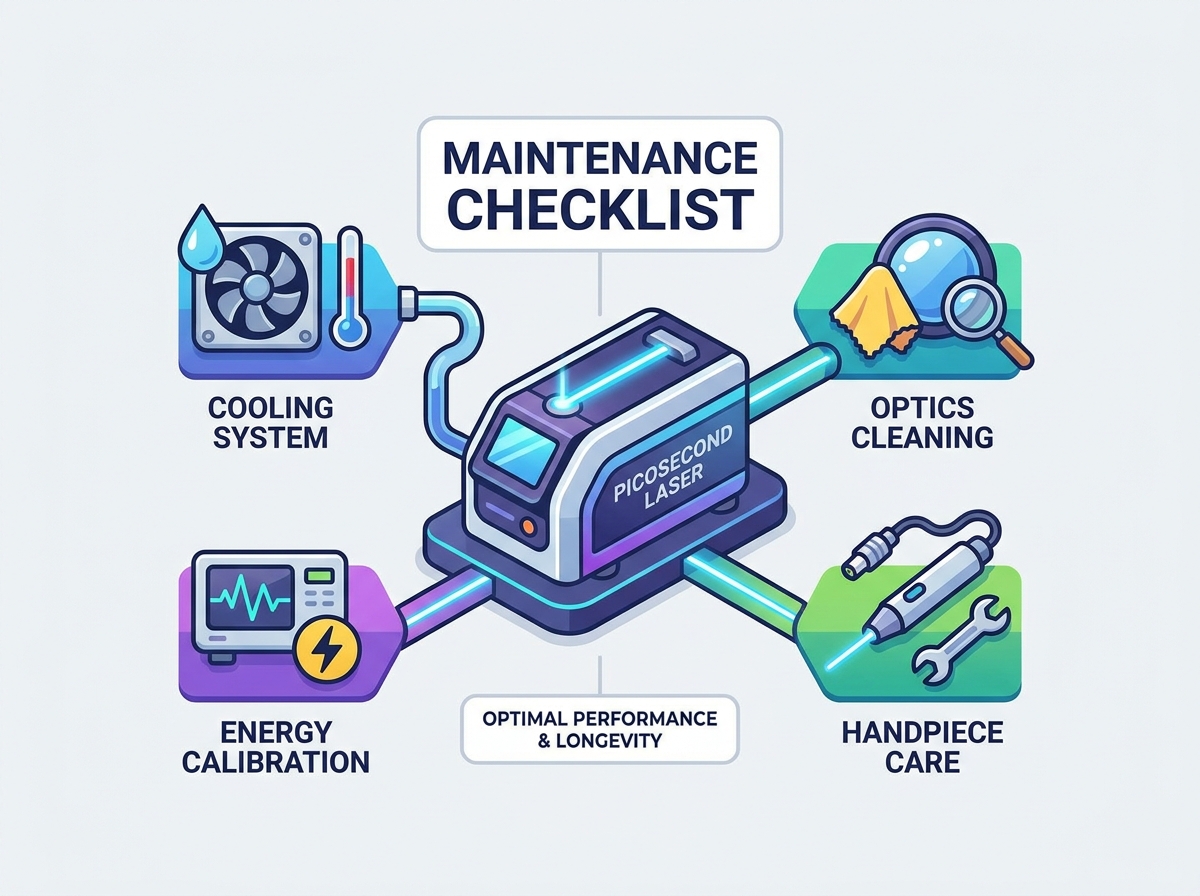
Thermal management dictates the stability of ultra-short pulses. You must use only distilled or deionized water, as specified by the manufacturer. Tap water introduces mineral scaling and causes galvanic corrosion on internal electrodes. Check water levels weekly. Completely drain and replace the coolant according to the manufacturer's schedule, typically every few months. The conductivity of the water changes over time as it absorbs ions from the internal plumbing. High conductivity leads to electrical arcing within the laser head. Use a handheld conductivity meter to test the water monthly. If the micro-siemens reading exceeds the manufacturer's limit, drain the reservoir immediately, flush the lines, and refill with fresh deionized water.
Monitor the system for temperature warnings during operation. Specific flow-rate errors indicate underlying issues like pump degradation or line blockages. Optimal operating temperatures directly correlate with the stability of picosecond pulse generation. If the system runs hot, the active laser medium loses efficiency, leading to energy fluctuations. A failing water pump often emits a high-pitched whine before it triggers a flow error code. Train your staff to listen for these auditory cues. If the flow rate drops, the flashlamp cannot cool fast enough between pulses. This thermal stress warps the laser rod and degrades the cavity reflectors, resulting in a massive drop in output energy.
Water filters and particulate filters require strict replacement timelines. A clogged filter restricts flow, causing rapid overheating. You cannot visually determine if a micron filter is clogged; you must adhere to the replacement schedule.
Replace particulate filters every three to six months based on patient volume and usage hours.
Flush the cooling lines completely during coolant changes to remove stagnant water.
Remove biological growth, chemical deposits, or particulate accumulation during the flush using approved algaecides if recommended.
Verify all O-rings and seals are intact and lubricated with silicone grease after replacing filters.
Run the system in standby mode for ten minutes after a filter change to bleed trapped air from the cooling lines.
Companion cooling systems, such as Zimmer cold-air units or integrated cryogen spray modules, demand equal attention. Check cryogen nozzle alignment to ensure precise epidermal cooling. Purge lines regularly to prevent blockages. Clean companion chiller air filters weekly to maintain optimal airflow and compressor efficiency. A blocked air filter on a skin chiller causes the compressor to overheat and shut down mid-treatment. Defrost the chiller coils monthly to prevent ice build-up, which restricts airflow. For cryogen systems, weigh the canisters to track usage and ensure you have adequate supply before starting a full-face resurfacing treatment.
Flashlamps have a natural lifecycle. Energy output naturally degrades over millions of pulses. Active laser mediums, such as Alexandrite or Nd:YAG crystals used in picosecond laser equipment, are affected by flashlamp aging and localized thermal stress. Use internal software diagnostics to track voltage compensation. As the flashlamp ages, the system draws more voltage to maintain the same output. High voltage compensation indicates a flashlamp nearing end-of-life. Do not wait for the lamp to shatter. A shattered flashlamp destroys the laser cavity and requires a complete rebuild. Track your pulse counts diligently and schedule a lamp replacement when the voltage compensation reaches the upper threshold defined in your service manual.
Beam profiling measures the spatial energy distribution of the laser pulse. It ensures a uniform "top-hat" profile or precise fractional energy distribution. Irregular beam profiles lead to dangerous hot spots. These hot spots increase the risk of patient scarring and uneven clinical results. Routine profiling catches optical degradation before it impacts patient safety. You can perform a basic burn-paper test to check for gross alignment issues, but true beam profiling requires a specialized camera system. If your burn paper shows a crescent shape or a dense center with weak edges, your optics are misaligned or damaged. Stop treating patients immediately and call a technician.
Daily user-level calibration involves firing into a built-in calibration port to verify basic output. Deep system calibration requires professional intervention. Technicians use external energy meters, specialized pulse detectors, and oscilloscopes to tune the system. Establish a baseline frequency for professional preventative maintenance visits, typically bi-annually or annually, depending on patient volume. The internal energy meter drifts over time. A technician will calibrate the internal meter against a NIST-traceable external joulemeter. This ensures that when you select 2.0 Joules on the screen, the machine actually delivers 2.0 Joules to the tissue.
Maintenance Task | Frequency | Responsible Party | Key Indicator of Failure |
|---|---|---|---|
Inspect/Clean Handpiece Optics | Daily | Laser Operator | Visible dust, pitting, or beam distortion |
Check Water Levels & Conductivity | Weekly | Clinic Staff | Low coolant error codes, arcing sounds |
Test Safety Interlocks | Weekly | Clinic Staff | System fails to disable upon door opening |
Replace Coolant and Filters | 3-6 Months | Certified Technician / Trained Staff | Flow rate errors, overheating warnings |
Deep Energy Calibration | Annually | Certified Technician | High voltage compensation, energy drop-off |
Articulated Arm Alignment Check | Bi-Annually | Certified Technician | Loss of energy at the handpiece, crescent burn pattern |
Calculate the true cost of maintaining your equipment over a multi-year period. Factor in routine consumables, scheduled preventative maintenance visits, and potential major part replacements like laser heads or power supplies. Relying solely on ad-hoc repairs often results in higher cumulative expenses due to emergency dispatch fees and extended downtime. A single laser head replacement can cost tens of thousands of dollars. Budgeting for a service contract smooths out these financial spikes. You must analyze your clinic's risk tolerance. If you operate a high-volume practice where a downed laser costs thousands of dollars a day in lost revenue, a comprehensive service agreement is mandatory.
Original Equipment Manufacturer (OEM) service contracts guarantee proprietary parts and official software updates. They provide the highest level of factory support. Certified third-party ISOs may offer faster regional dispatch and lower premium costs. Evaluate these trade-offs carefully. Ensure any ISO you select employs technicians specifically trained on your exact device model. Ask the ISO for references from other clinics using the same equipment. Verify that they have access to genuine replacement parts, especially for critical components like flashlamps and optical mirrors. Using aftermarket parts can alter the pulse duration, compromising the picosecond acoustic effect.
Maintaining detailed maintenance logs is a legal and financial necessity. Using unauthorized parts or skipping scheduled maintenance can void expensive manufacturer warranties. Document every filter change, optical cleaning, and calibration check. This paper trail protects your practice during warranty claims and liability audits. Keep a physical logbook attached to the machine. Require operators to sign off on daily checks before firing the first pulse. If a patient claims they were burned during a treatment, your maintenance log proves that the machine was calibrated, the optics were clean, and the safety systems were functional on that specific day.
Catching issues early prevents catastrophic damage. Train staff to recognize specific auditory, visual, and tactile warning signs. Ignoring these signs leads to expensive repairs.
Auditory: Listen for unusual arcing sounds inside the chassis or high-pitched pump whining.
Visual: Watch for a diminished aiming beam, flickering interface screens, or recurring software error codes.
Tactile: Notice if the handpiece, articulated arm, or power cord feels unusually hot during operation.
Operational: Pay attention to increased warm-up times or the system struggling to reach the requested energy level.
Staff negligence poses a significant operational risk. Operators must understand how their handling impacts hardware longevity. Implement standard operating procedures (SOPs) for daily handover checklists between laser operators. Clear accountability ensures that delicate optics are cleaned and safety checks are performed consistently. Do not allow untrained staff to wipe down the lenses. A single swipe with a rough paper towel will destroy a thousand-dollar optic. Conduct quarterly training refreshers on proper handling techniques, focusing on how to detach and store handpieces without dropping them.
External factors heavily impact laser health. Maintain strict ambient room temperature and humidity control to prevent internal condensation. Ensure dust-free ventilation around the device. Utilize Uninterruptible Power Supplies (UPS) or dedicated electrical circuits to protect sensitive internal electronics from power surges. A picosecond device draws massive current during the flashlamp discharge. If it shares a circuit with an air conditioner or a centrifuge, the voltage drop will cause the laser to fault. Keep the room temperature between 65 and 72 degrees Fahrenheit. High ambient heat forces the internal cooling system to work harder, accelerating component wear.
Download and implement a standardized daily and weekly maintenance log sheet for all operators to sign.
Audit your current cooling system protocols to ensure you are using the correct deionized water and replacing filters on schedule.
Review your existing service agreement to verify coverage for major components like flashlamps and optical arms.
Schedule a comprehensive system health check with a certified technician if your device has not been professionally calibrated in the last twelve months.
Order backup protective windows and high-purity optical cleaning supplies to prevent downtime from dirty lenses.
A: You should completely drain and replace the cooling water every 3 to 6 months, depending on usage and manufacturer guidelines. Always use distilled or deionized water as specified to prevent mineral scaling and internal corrosion.
A: Use high-purity isopropyl alcohol and specialized optical wipes. Gently wipe the surface without applying excessive pressure. Never use abrasive cloths or standard paper towels, as they will scratch the anti-reflective coating.
A: A dim or distorted aiming beam usually indicates debris or pitting on the protective window or internal lenses. It can also point to a slight misalignment in the articulated arm. Inspect and clean the optics immediately.
A: No. Tap water contains minerals that will immediately begin scaling internal components and causing galvanic corrosion on electrodes. Always keep a reserve supply of the manufacturer-approved deionized or distilled water on hand.
A: The system will typically show high voltage compensation through internal diagnostics, meaning it is working harder to produce the same energy. You may also notice a gradual drop in clinical efficacy or inconsistent pulse delivery.
A: Stop the treatment immediately. A hot handpiece indicates a failure in the cooling system, a blocked flow line, or severe optical damage absorbing the laser energy. Continuing to fire will cause permanent hardware damage.

 Copyright © 2021 Shanghai Apolo Medical Technology Co., Ltd All Right Reserved. Sitemap Support By Leadong


