
+86-21-34622842(REP.) +86-21-34622015(REP.)
- All
- Product Name
- Product Keyword
- Product Model
- Product Summary
- Product Description
- Multi Field Search
Views: 0 Author: Site Editor Publish Time: 2026-09-10 Origin: Site
Acquiring aesthetic laser equipment requires a significant capital expenditure. You face immense business risk if you procure substandard technology. Clinics rely entirely on these critical systems to generate consistent, safe revenue streams. Patients expect flawless results from high-ticket dermatological treatments.
The 10600nm fractional CO2 laser remains the undisputed gold standard for skin resurfacing and scar revision. However, the current aesthetic market is flooded with varying degrees of machine quality. Unreliable, poorly manufactured machines can jeopardize patient safety and permanently damage your clinic reputation.
This article provides a highly skeptical, evidence-backed evaluation framework. We want to help you actively separate clinical-grade medical systems from unreliable white-label aesthetic devices. You will learn exactly how specific internal components dictate clinical outcomes. We will outline the precise technical specifications you must scrutinize before finalizing any vendor purchase order.
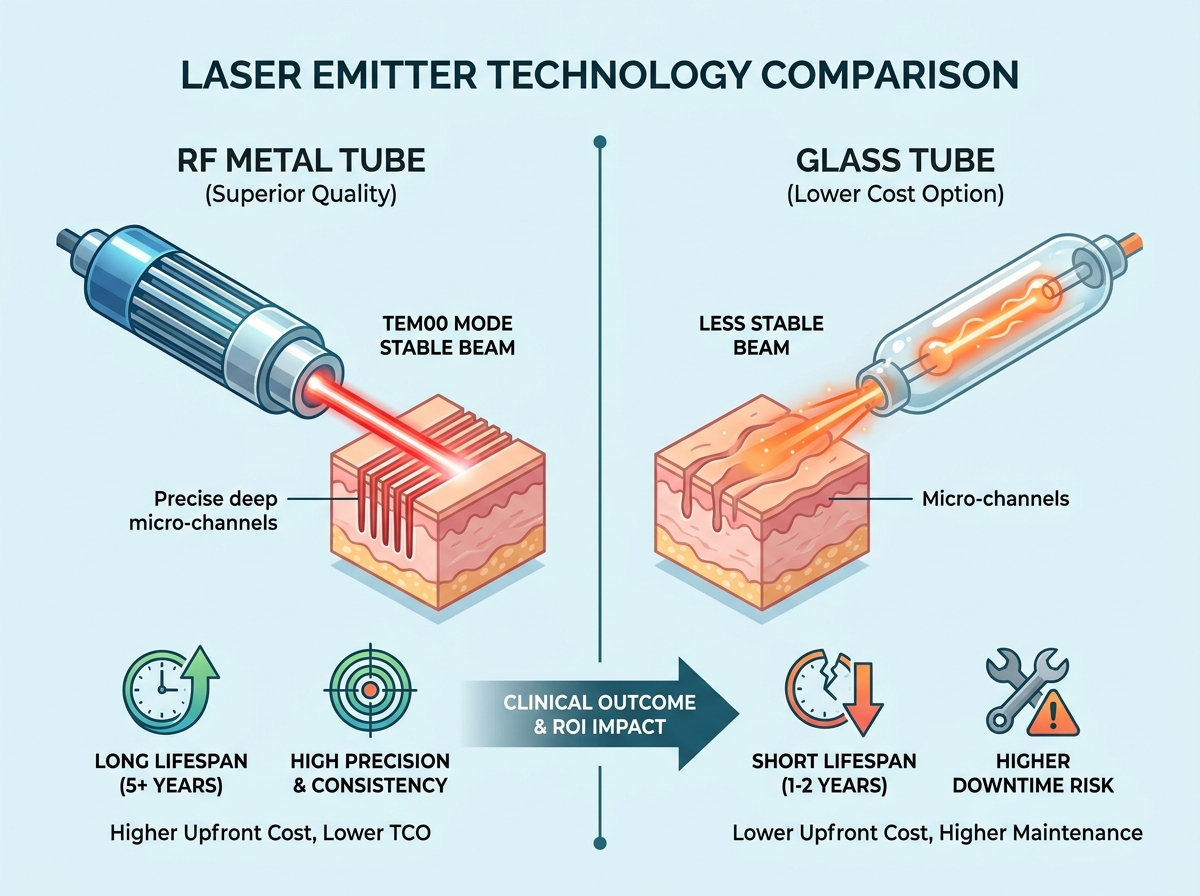
The choice between RF (Radio Frequency) metal tubes and DC glass tubes fundamentally alters device lifespan, beam precision, and patient downtime.
A versatile fractional CO2 laser product range should support multiple handpieces (fractional, surgical, gynecological) to maximize clinic ROI.
Verifying CO2 laser equipment certificates (FDA 510(k), Medical CE) is non-negotiable for medical malpractice insurance and patient safety.
Upfront cost is only one metric; evaluate Total Cost of Ownership (TCO) including training programs, warranty terms, and preventative maintenance.
We must evaluate the core engine of the machine first. The laser tube dictates almost everything about long-term performance. You will typically choose between an RF metal tube and a DC glass tube. RF metal tubes produce a vastly superior TEM00 beam mode. This mode guarantees a perfectly round, uniform energy profile. Glass tubes often produce highly irregular beam shapes. Irregular beams create uneven tissue ablation and severely prolong patient healing times.
Furthermore, RF metal tubes offer exceptional power stability. They pulse much faster than glass alternatives. Faster pulsing minimizes collateral heat damage to surrounding healthy tissue. RF tubes usually last five or more years before requiring factory refurbishment. Glass tubes typically fail completely within one to two years. The lower upfront cost of glass tubes usually leads directly to higher clinic downtime. You will inevitably face frequent, frustrating replacement costs.
Feature | RF Metal Tube | DC Glass Tube |
|---|---|---|
Beam Quality | Excellent (TEM00 Mode) | Inconsistent / Irregular |
Pulse Duration | Ultra-short, precise | Longer, causes more thermal damage |
Lifespan | 5+ years | 1 - 2 years |
Power Stability | Highly stable across sessions | Fluctuates as tube degrades |
Precise control over micro-ablative columns is absolutely critical. Practitioners routinely perform high-risk treatments like deep surgical scar revision. These intense procedures demand pinpoint accuracy from your equipment. If your spot size fluctuates unexpectedly, you risk inflicting severe thermal damage.
A true clinical-grade system must offer fine-tuned adjustable parameters. You should easily control the density of the fractional grid. You need to adjust the penetration depth seamlessly during a session. Pulse energy adjustments must be incredibly granular. We recommend looking for systems offering distinct micro-pulse adjustments. This level of control allows you to customize treatments effortlessly. You can seamlessly switch between superficial epidermal peeling and deep dermal coagulation.
Many buyers mistakenly overlook the articulated arm assembly. This component is vital for maximum optical transmission efficiency. You should always demand a 7-joint articulated arm. High-quality arms utilize premium internal optical mirrors. These mirrors ensure maximum laser energy reaches the target tissue. Poorly constructed arms lose significant energy at every single joint.
Arm balance directly affects practitioner physical fatigue. You might perform back-to-back resurfacing sessions all day long. A heavy, stiff arm causes severe wrist strain over time. It noticeably reduces your precision during intricate surgical procedures. A well-balanced arm feels almost weightless in the hand. It moves fluidly and locks securely into position without drifting.
You need a laser system designed for multi-disciplinary clinic use. Evaluate how easily the machine switches operating modes. You will likely perform aesthetic treatments for fine lines and wrinkles. You might also need surgical modes for lesion excision or blood coagulation. A truly versatile system adapts instantly to changing clinical needs.
Review the comprehensive breadth of the vendor's offerings carefully. A robust fractional CO2 laser product range should include specialized optical scanners. Does the manufacturer offer dedicated handpieces for ENT procedures? Can you attach dental or vaginal rejuvenation adaptors safely? Multiple handpieces actively maximize your overall clinic ROI. They allow you to cross-sell highly profitable services to your existing patients.
The software interface actively dictates your daily operational efficiency. Assess the presence of pre-set clinical protocols on the home screen. Good software guides new practitioners safely through standard procedures. However, you also need completely open manual controls. Experienced laser operators require fully customizable settings for highly complex dermatological cases.
Be extremely cautious of proprietary software systems. Some aggressive manufacturers lock clinics out of basic troubleshooting menus entirely. They force you to schedule expensive technician visits for minor calibration issues. You want an interface offering transparent, built-in diagnostic tools.
Look for these must-have UI features:
Real-time energy delivery readouts.
Adjustable dwell time and spacing parameters.
One-touch toggling between fractional and continuous wave modes.
Clear error code displays for rapid troubleshooting.
Legal operation requires highly specific regulatory documentation. You must verify baseline CO2 laser equipment certificates before signing a contract. US clinics absolutely need an FDA 510(k) clearance document. European buyers must demand formal Medical CE (MDR) certification. Furthermore, always check for ISO 13485 compliance. This standard ensures rigorous manufacturing quality control at the factory level.
Uncertified "factory-direct" imports carry massive, practice-ending risks. Operating uncertified devices can instantly void your clinic liability insurance. You expose your practice to devastating patient lawsuits. You also risk inflicting permanent, disfiguring patient injuries. Always request original certificate copies directly from the Notified Body.
Follow these steps to verify compliance:
Ask the vendor for the exact FDA 510(k) summary number.
Search this number directly in the official FDA online database.
For CE marks, request the Declaration of Conformity.
Verify the Notified Body number listed next to the CE mark.
Robust safety mechanisms protect both the patient and the practitioner. Check for internal energy calibration systems within the chassis. These systems ensure the screen output matches the actual tissue delivery. A laser losing calibration can cause severe burns without any warning.
Look for integrated smoke evacuator connections near the handpiece. Ablative procedures generate hazardous, biologically active laser plume. You must fiercely protect your staff from inhaling vaporized particles. Finally, confirm the presence of robust safety interlock mechanisms. These physical switches instantly cut laser power if a treatment room door opens unexpectedly.
A strong, transparent warranty protects your upfront capital investment. Define what a comprehensive warranty actually covers in writing. Does it cover both replacement parts and on-site labor? Many cheap warranties only cover the physical parts. They charge exorbitant hourly rates for mandatory technician labor.
Verify the specific coverage duration for the laser tube itself. This component is consistently the most expensive part to replace. Establish highly realistic expectations for preventative maintenance schedules. Ask vendors for a transparent, itemized list of annual maintenance requirements. Know exactly what filters and coolant fluids require regular swapping.
Do not underestimate the massive value of clinical training. Evaluate the vendor’s training program thoroughly before buying. Digital PDF manuals and pre-recorded videos are entirely insufficient. You need hands-on, on-site clinical training utilizing real patients. Expert trainers help your staff master complex parameters quickly and safely.
Implementation reality is often quite harsh. A high-end machine paired with poor practitioner training yields terrible clinical results. Conversely, a mid-tier machine operated by a highly trained expert produces excellent outcomes. Invest heavily in vendors who prioritize continuous, high-level clinical education.
Buyers frequently discuss the tempting "under $40k" pricing threshold. B2B procurement teams often target this specific number to save money. You must understand exactly what components vendors sacrifice to hit these low price points. They almost always use cheaper, unreliable glass tubes. They utilize inferior optical mirrors inside the articulated arm.
Budget vendors also lack dedicated US or EU service support teams. When your budget machine breaks down, you wait weeks for international shipping. These severe sacrifices drastically reduce daily machine reliability. The initial financial savings quickly evaporate due to missed appointments, refunds, and reputational damage.
Carefully analyze the true cost of ongoing treatment consumables. Evaluate the price of replacement fractional tips and protective optical lenses. Compare these recurring costs against average treatment pricing in your local market. Unreasonably high consumable costs eat directly into your hard-earned profit margins.
Define the break-even patient volume very carefully. Use verifiable local treatment rates for your financial calculations. An open-architecture machine drastically minimizes ongoing clinic expenses. It allows you to reach true profitability much faster. Always model your financial projections on highly conservative patient volume estimates.
This strict evaluation framework helps you make informed, confident purchasing decisions. Prioritize core tube quality above all other flashy features. RF metal tubes consistently ensure surgical precision and long-term reliability. Verify all regulatory compliance documents thoroughly to protect your business. Guard your clinic from unnecessary liability risks by avoiding cheap imports. Mandate robust, hands-on post-sale training from your chosen vendor.
Encourage your procurement team to demand total transparency. Request detailed clinical whitepapers and original regulatory certificate copies. Insist on real-world clinic demo periods before finalizing your vendor shortlist. Actionable, skeptical evaluation prevents catastrophic and costly mistakes. Contact our expert team today for a compliance-checked product consultation. You can also request a detailed Request for Proposal (RFP) template to streamline your vendor assessment process.
A: The machine chassis typically lasts over a decade with proper care. However, the laser tube lifespan varies. High-quality RF metal tubes generally last 5 to 7 years (roughly 10,000 to 20,000 operational hours) before requiring factory gas recharging. DC glass tubes usually degrade and require complete replacement within 1 to 2 years.
A: Yes, absolutely. A clinical-grade system manages both effectively, provided it features high peak power and adjustable micro-pulse capabilities. You can configure deep, high-energy pulses for severe acne scars, and switch to short, low-energy pulses for superficial epidermal peeling.
A: Do not trust digital images alone. For FDA 510(k) clearance, ask for the K-number and verify it directly on the FDA’s official online database. For European Medical CE marks, request the original Declaration of Conformity and cross-reference the registered Notified Body number.
A: It depends heavily on the manufacturer. Some brands use open-architecture systems where only standard protective lenses require replacement. Others force clinics into expensive ecosystems using vendor-locked RFID tips that expire after a set number of pulses. Always clarify this before purchasing.


 Copyright © 2021 Shanghai Apolo Medical Technology Co., Ltd All Right Reserved. Sitemap Support By Leadong


