
+86-21-34622842(REP.) +86-21-34622015(REP.)
- All
- Product Name
- Product Keyword
- Product Model
- Product Summary
- Product Description
- Multi Field Search
Views: 0 Author: Site Editor Publish Time: 2026-09-30 Origin: Site
Your clinic has established a solid business case for tattoo removal. You are now evaluating specific devices to launch this high-demand service. The aesthetic market currently experiences rapid growth. However, this lucrative sector is heavily flooded with gray-market imports. Many suppliers sell deliberately mislabeled devices. Purchasing a non-compliant machine introduces severe clinical, financial, and legal liabilities. A bad purchase can easily derail your entire operation.
Medical directors and clinic owners need a rigorous, evidence-based checklist for verifying manufacturer claims. Relying on glossy brochures is no longer enough. You must scrutinize the underlying regulatory paperwork. This article provides exactly this framework. You will learn how to ensure your procured device meets strict legal standards. We outline the exact documents you must request from vendors. This diligence ultimately protects your patients and your practice viability.
A manufacturer’s marketing claim of being "FDA-Cleared" must be independently verified through the FDA’s 510(k) Premarket Notification database.
Malpractice insurance policies routinely void coverage if a patient is injured by a device lacking proper regulatory clearance.
Technical specifications on marketing brochures (e.g., true picosecond pulse durations) must align exactly with the indications for use listed in the official FDA clearance documents.
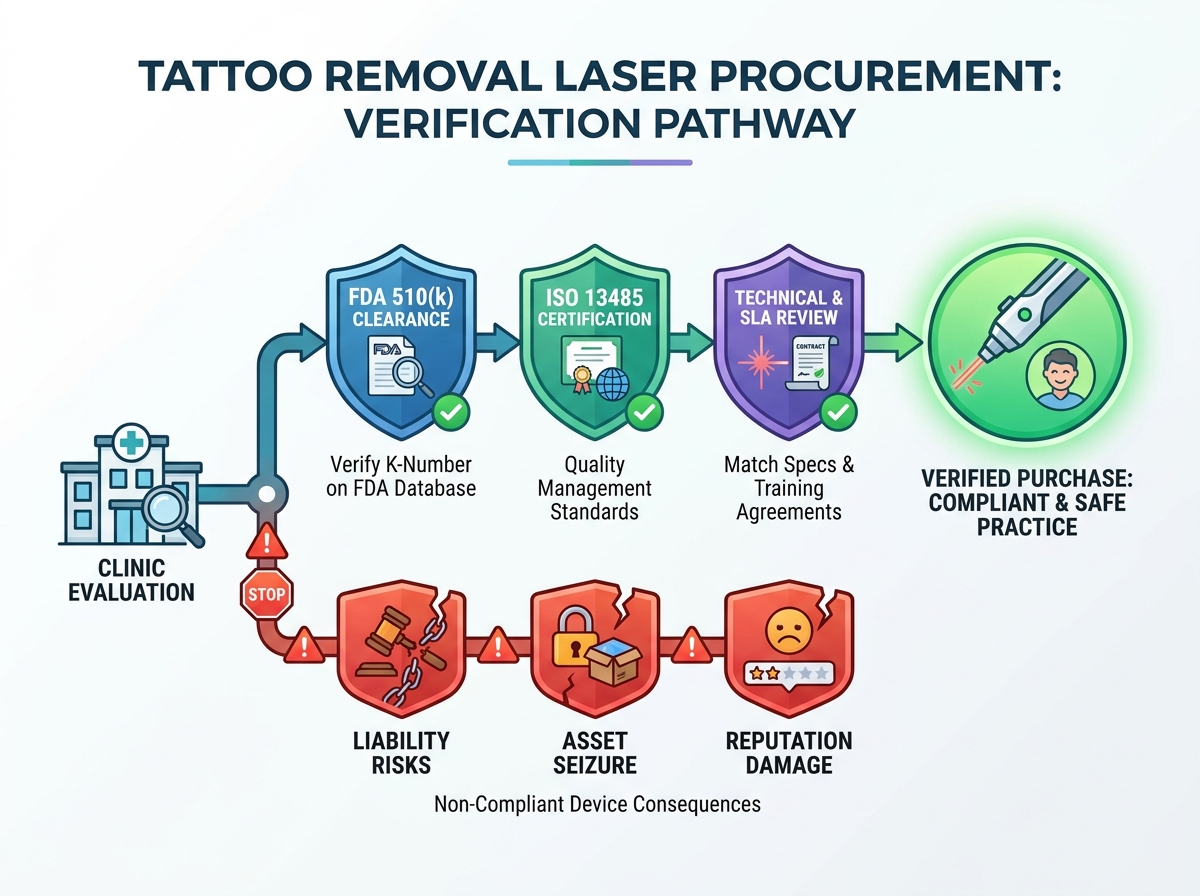
Comprehensive procurement requires verifying not just the FDA 510(k), but also ISO certifications, clinical training SLAs, and robust warranties.
Operating unverified medical devices carries immense risk. You face threats extending far beyond simple equipment malfunction. The stakes involve your entire business livelihood. Clinics must understand these distinct liability categories before making any purchasing decisions.
Clinical liability coverage protects your practice during adverse events. Severe hyperpigmentation or scarring can trigger immediate patient lawsuits. Insurers meticulously investigate these medical claims. They always check the regulatory status of your clinic's equipment. Operating non-cleared devices can instantly nullify your clinical liability coverage. Insurers view unapproved devices as a fundamental breach of contract. This leaves the clinic owner personally liable for all damages. Out-of-pocket legal fees can easily bankrupt a growing aesthetic practice. You must secure written proof of clearance to maintain valid insurance protection.
Government agencies strictly monitor medical device usage across the country. The FDA and state medical boards frequently conduct compliance audits. Inspectors actively look for counterfeit or gray-market laser systems. Operating unapproved machines invites severe federal penalties. Authorities can execute unannounced confiscations of counterfeit devices. They will physically remove the equipment from your premises. State boards can also force immediate clinic closures. You might face hefty regulatory fines or practitioner license suspensions. Recovering from this level of regulatory action is often impossible for small businesses.
Patient satisfaction drives aesthetic clinic profitability. Utilizing unverified technology fails to deliver consistent ink clearance. Stubborn ink then requires excessive, painful treatment sessions. Patients notice when treatments fall significantly short of promises. They will inevitably leave negative online reviews. Negative word-of-mouth destroys your local brand reputation. This severely impacts your long-term return on investment. Quality equipment builds lasting trust in your community. Cheap, unverified alternatives destroy patient confidence permanently.
Trusting a salesperson is never a viable procurement strategy. You must demand hard evidence of regulatory compliance. The following documents represent the bare minimum requirements for any legitimate aesthetic laser system.
Buyers must request the exact 510(k) number from vendors. Industry professionals often call this the K-number. Do not accept a simple "FDA Cleared" badge on a website. You must cross-reference this K-number on the official FDA Accessdata database. The database confirms if the medical clearance is genuinely active. It shows exactly who currently holds the legal clearance. Verify the company name perfectly matches your chosen vendor. If the names differ, you might be buying an unauthorized replica.
Clearance is highly specific to certain clinical treatments. Lasers are never cleared for blanket medical use. The FDA specifies particular ink colors or patient skin types. Read the official Indications for Use statement very carefully. You must ensure the documented indications match your intended services. Using a device off-label carries significant clinical risk. A laser cleared only for black ink cannot be marketed for multi-color removal. Treating darker skin types requires specific clearances based on the Fitzpatrick scale.
The actual manufacturing facility itself must be officially registered. You should verify this establishment registration online through federal portals. Registered facilities remain subject to strict regulatory quality inspections. This prevents the purchase of white-labeled, untraceable overseas imports. You want a clear, verifiable chain of custody. Knowing the true manufacturer ensures accountability for safety defects. It guarantees they follow established good manufacturing practices. Unregistered facilities often cut dangerous corners to lower production costs.
Table 1: Distinguishing Genuine Regulatory Claims from Fraudulent Marketing
Feature | Legitimate Manufacturer | Fraudulent/Gray-Market Vendor |
|---|---|---|
Documentation Provided | Full 510(k) clearance letter and official K-number. | Vague certificates or unauthorized CE marks. |
Database Status | K-number actively verifiable on the FDA Accessdata portal. | K-number returns zero results or points to a different company. |
Indications Match | Marketing strictly matches the official Indications for Use. | Marketing promises blanket cures for all ink colors. |
Facility Registration | Factory is listed in the FDA Establishment Registration database. | No traceable factory address; relies on third-party drop-shipping. |
Federal clearance provides a baseline for clinical safety. However, world-class clinics look for broader indicators of manufacturing excellence. International standards provide a deeper look into a vendor's reliability.
Domestic clearance is only one part of the puzzle. ISO 13485 represents the international gold standard for manufacturing. It applies specifically to medical device quality management systems. This certification proves the manufacturer maintains rigorous production controls. It ensures consistent manufacturing quality across every single machine built. Audits for this standard are thorough and highly uncompromising. Clinics should always request the most current ISO 13485 certificate. Expired certificates indicate a lapse in quality control oversight.
You must ask for a complete compliance portfolio. Reputable manufacturers gladly provide these organized document packets upfront. Reviewing standardized compliance packets like Apolo medical device certificates can serve as an excellent benchmark. They demonstrate the precise level of transparency a reputable manufacturer should provide. A proper dossier includes electrical test reports and clinical safety declarations. If a vendor hesitates to share these documents, consider it a massive red flag. Transparency is non-negotiable in aesthetic medicine.
Many aesthetic clinics operate internationally across different jurisdictions. Others simply seek additional layers of device safety validation. Checking for European Medical Device Regulation compliance is highly recommended. The CE mark provides supplementary proof of rigorous safety testing. MDR compliance is notoriously strict regarding clinical evaluation data. Devices passing this hurdle demonstrate exceptional safety profiles. It offers immense peace of mind for your clinical team. Gathering both US and EU documentation ensures maximum risk mitigation.
Marketing departments often inflate technical specifications to drive sales. Clinics must act as scientific investigators during the procurement phase. You must bridge the gap between marketing claims and proven physics.
Marketing brochures frequently exaggerate crucial technical specifications. You must rigorously evaluate these claims before signing contracts. When evaluating an FDA-cleared picosecond tattoo removal laser, carefully verify the documented pulse duration. It must be measured in true picoseconds. Ensure this metric perfectly matches the clinical data submitted to the FDA. This guards against "fake pico" devices currently flooding the market. Many cheap imports are actually older nanosecond lasers disguised in deceptive casing. True picosecond technology requires immense engineering precision to generate a photomechanical effect.
Different tattoo ink colors require specific laser wavelengths for removal. When assessing a standard Q-switched ND:YAG tattoo removal machine, you must verify documented efficacy. The device needs powerful 1064nm capabilities for targeting dark inks. It also requires stable 532nm capabilities for clearing warm inks. Verify these bold claims against independent clinical whitepapers. The manufacturer should willingly provide these peer-reviewed studies. Do not rely solely on in-house, unpublished marketing data. Independent validation ensures the device actually performs as advertised.
Laser physics heavily influence clinical outcomes and patient safety. The concept of thermal relaxation time is absolutely vital here. You must establish a strong physics-to-documentation link during evaluation. Ensure the technical manual supports the safe, effective shattering of ink. The laser pulse must be drastically shorter than the target's thermal relaxation time. This shatters the pigment without damaging the surrounding skin tissue. This exact mechanism must be proven in the 510(k) clinical trials. Improper thermal management leads directly to permanent patient scarring.
Common Technical Discrepancies to Watch For:
Overstated peak power figures not matching official FDA submissions.
Claimed spot sizes losing energy density at maximum settings.
Fake picosecond pulse widths operating entirely in the nanosecond range.
Unverified internal cooling mechanisms lacking clinical safety data.
Inconsistent beam profiles causing uneven energy distribution.
Hardware quality is only half the procurement equation. The post-purchase support structure determines your long-term clinical success. Clinics must scrutinize operational contracts just as closely as regulatory clearances.
Buying the machine is only the first step. Operating it safely requires intensive, hands-on practitioner education. Insist on documented, manufacturer-provided training programs for your staff. A brief video tutorial is completely unacceptable in aesthetic medicine. Malpractice insurance providers often require formal certificates of training. You must obtain these physical certificates from the vendor for all operating practitioners. Comprehensive training drastically reduces adverse events. It also significantly improves overall patient outcomes.
Laser systems are complex, highly sensitive optical instruments. They require regular calibration and professional maintenance. Outline exactly what a standard commercial warranty should cover. Flashlamp lifespans must be clearly defined in writing. Articulated arm alignment should be fully included in the coverage. You must secure a guaranteed, written response time for technical support. Extended equipment downtime translates directly to lost clinic revenue. Ensure the contract includes mandatory annual preventative maintenance visits.
Modern lasers rely heavily on proprietary components and advanced software. You need a clear understanding of all ongoing operational requirements. Ensure the contract clearly defines the ongoing costs of replacement parts. Ask for fixed pricing on protective lenses and flashlamps. The agreement must also guarantee access to future software updates. Firmware compliance patches keep your device operating safely. Avoid vendors who charge exorbitant hidden fees for critical safety patches.
Do not issue a Purchase Order prematurely. You must possess the 510(k) clearance letter first. Secure the ISO certification and a signed SLA before transferring any funds. Rigorous documentation verification heavily protects the clinic's bottom line. It ensures uncompromising patient safety while maintaining your operational legality. Pausing to verify facts separates successful clinics from failed ones. We strongly advise procurement teams to halt current evaluations immediately. Request the outlined documentation from your shortlisted vendors today. Demand total transparency from your partners. Protect your business investment and your patients.
A: Navigate to the FDA 510(k) Premarket Notification database online. Enter the exact K-number provided by the manufacturer into the search bar. The database will display the applicant name, device name, and clearance date. Compare this official data directly against your vendor's marketing materials. If the names or indications differ, investigate further before purchasing.
A: No, they are entirely different concepts. "FDA Registered" simply means a facility paid a fee to register their physical location. It involves no product safety testing. "FDA Cleared" means the manufacturer submitted clinical evidence proving the device is safe and effective. Deceptive marketers often use "Registered" to trick buyers.
A: Buying second-hand introduces unique clinical risks. You must verify the original FDA compliance status of the specific serial number. Additionally, check the transferability of warranties and software licenses. Many manufacturers refuse to service used devices without a hefty recertification fee. Always demand the original clearance paperwork and service logs from the seller.


 Copyright © 2021 Shanghai Apolo Medical Technology Co., Ltd All Right Reserved. Sitemap Support By Leadong


