
+86-21-34622842(REP.) +86-21-34622015(REP.)
- All
- Product Name
- Product Keyword
- Product Model
- Product Summary
- Product Description
- Multi Field Search
Views: 0 Author: Site Editor Publish Time: 2026-07-06 Origin: Site
The evolution of aesthetic and dermatological laser technology has shifted focus from traditional nanosecond domains to ultrashort picosecond pulse durations, fundamentally altering tissue interaction dynamics. Clinic owners and medical directors face a complex capital equipment decision: determining if the higher acquisition cost of a picosecond device is justified by its clinical efficacy, or if an established nanosecond system remains sufficient for their specific patient demographic and service offerings. This guide provides a rigorous technical and operational comparison between picosecond and nanosecond Nd:YAG technologies. By evaluating pulse duration physics, peak power outputs, and clinical endpoints, practitioners can make evidence-based procurement decisions that align with their clinical goals. We will examine the mechanical differences, tissue responses, and operational realities of integrating these systems into a high-volume practice.
Physics of Pulse Duration: Nanosecond lasers rely primarily on photothermal effects, whereas picosecond lasers operate below the stress relaxation time of target chromophores, generating a predominantly photoacoustic (mechanically destructive) effect.
Peak Power Discrepancy: A picosecond Nd:YAG laser delivers significantly higher peak power over a shorter duration, resulting in finer fragmentation of exogenous ink and endogenous pigment with reduced collateral thermal damage.
Clinical Efficiency: Evidence indicates picosecond pulses achieve faster clearance rates for recalcitrant and black tattoos, requiring fewer overall treatment sessions compared to nanosecond counterparts.
Equipment ROI and Trade-offs: While a picosecond Nd:YAG laser system commands a premium capital expenditure, it offers advanced scalability for high-volume clinics through premium treatment pricing and broader indications.
To evaluate clinical superiority, practitioners must first understand how pulse duration dictates the mechanism of action on target chromophores. The fundamental difference between these two technologies lies in how they deliver energy and how the target tissue absorbs and reacts to that energy. You cannot optimize treatment protocols without grasping the underlying physics of your equipment.
Traditional Q-switched lasers operate in the billionths of a second. This technology relies heavily on the Thermal Relaxation Time (TRT) of the target chromophore. When the laser energy strikes the pigment, it is absorbed and rapidly converted into heat. This sudden temperature increase causes the pigment to fracture through photothermal expansion. We have used this mechanism for decades, and it works well for large, dense ink particles.
While effective for many applications, this mechanism has inherent limitations. The longer tissue dwell time associated with nanosecond pulses increases the risk of thermal diffusion to surrounding healthy tissue. This excess heat can trigger adverse biological responses, potentially leading to post-inflammatory hyperpigmentation (PIH) or scarring, particularly in patients with darker skin types. When you fire a nanosecond pulse, you must actively manage epidermal cooling to mitigate this thermal spread.
In practice, nanosecond systems require careful fluence management. If you push the energy too high trying to clear stubborn ink, the thermal bulk heating becomes a liability. The tissue simply cannot dissipate the heat fast enough, leading to blistering and prolonged downtime for the patient.
Modern ultrashort pulse technology operates in the trillionths of a second. A picosecond Nd:YAG laser targets the Stress Relaxation Time (SRT) of the chromophore rather than just the Thermal Relaxation Time. By delivering energy at such an accelerated rate, the ultrashort pulse generates massive peak power that creates a localized shockwave. This photoacoustic effect shatters the pigment into microscopic, dust-like particles.
The primary advantage of this mechanism is the drastic reduction in thermal energy retention within the surrounding tissue. By converting optical energy into mechanical force rather than heat, practitioners can perform safer, more aggressive treatments on darker Fitzpatrick skin types without the same high risk of thermal damage. You see this immediately in the treatment room; the tissue response is different, with less collateral erythema.
This mechanical fragmentation is highly efficient. Because the energy is delivered so rapidly, the pigment particle undergoes catastrophic structural failure before heat can transfer to the adjacent cells. This acoustic stress confinement is what allows us to treat complex dermal pigmentation with a higher margin of safety.
The aesthetic laser market features several systems that utilize "sub-nanosecond" pulses, typically ranging from 900 to 950 picoseconds. These are often prolonged Q-switched profiles masquerading as true picosecond technology. Understanding this technical distinction is vital for accurate equipment evaluation. You must look at the actual pulse duration specifications, not just the marketing brochures.
True picosecond engineering requires the system to operate consistently in the 300 to 450 picosecond range. This specific duration maximizes peak power while fully respecting the mechanical confinement threshold necessary for optimal photoacoustic fragmentation. Pseudo-picosecond systems generate excessive photothermal heat compared to true picosecond devices. This reduces their photoacoustic efficiency and increases the risk of adverse thermal effects in delicate tissue, ultimately compromising clinical outcomes.
When testing equipment, pay attention to the clinical endpoints. A pseudo-picosecond device will often produce a tissue response very similar to a standard Q-switched laser, complete with significant thermal frosting and pinpoint bleeding. A true picosecond device will yield a much more controlled, less traumatic endpoint.
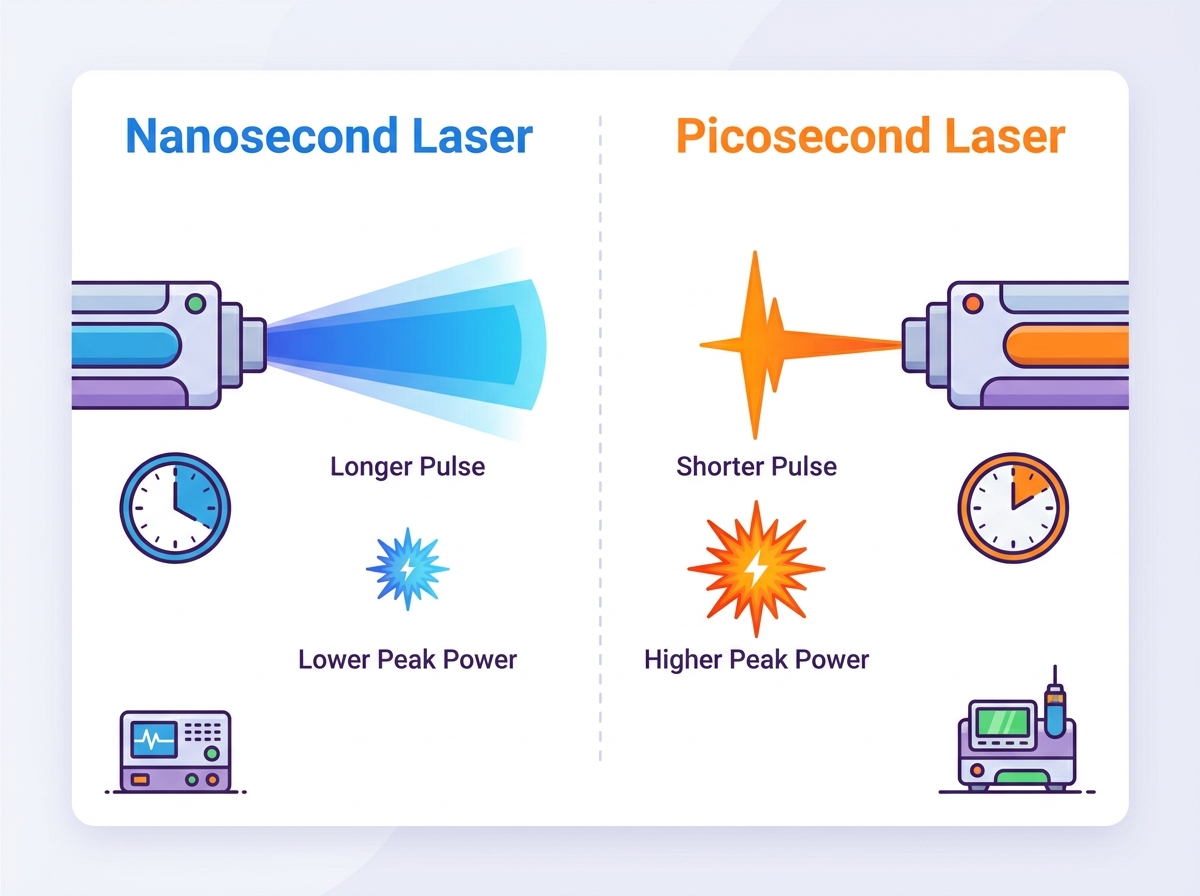
Assessing how equipment specifications translate to predictable clinical outcomes requires a deep dive into tissue interaction dynamics. The relationship between pulse duration, peak power, and the resulting biological effect dictates the efficiency of the treatment. You need to know exactly what happens under the skin when you press the foot pedal.
Nanosecond systems possess a high photothermal ratio and a moderate photoacoustic ratio. They are highly effective for breaking up larger pigment clusters but become progressively less efficient when dealing with residual or very small pigment particles. The heat generated can also become a limiting factor in how aggressively a practitioner can treat a specific area. You will often hit a plateau in tattoo clearance with nanosecond devices.
Conversely, picosecond systems exhibit a high photoacoustic ratio and a low photothermal ratio. The mechanical shockwave, driven by kinetic pressure wave propagation, is highly efficient at disrupting dense, small-particle chromophores without excessive heat buildup. Delivering pulse energy faster than the acoustic transit time across the target pigment limits thermal expansion. The energy converts directly into a highly localized mechanical shockwave, achieving acoustic stress confinement.
This shift from thermal to acoustic energy delivery changes the way we approach treatment parameters. With a high photoacoustic ratio, we rely less on raw fluence and more on the sheer peak power of the ultrashort pulse to do the work. This allows for effective fragmentation at lower overall energy settings, preserving epidermal integrity.
The biological clearance mechanism relies heavily on the body's immune system, specifically macrophage phagocytosis. Nanosecond lasers break pigment into pebble-sized fragments. While macrophages can engulf and remove these fragments, the process is relatively slow and often leaves larger pieces behind, necessitating further treatments. You are essentially relying on the body to do the heavy lifting over several months.
Picosecond lasers pulverize pigment into sand-like particles. This drastically smaller particle size directly correlates with accelerated lymphatic clearance. Macrophages can easily engulf and transport these microscopic particles away from the treatment site, resulting in faster visible clearance and fewer required treatment sessions for the patient. The efficiency of the lymphatic system is maximized when the particle size is minimized.
Technical Specification | Nanosecond (Q-Switched) Nd:YAG | Picosecond Nd:YAG |
|---|---|---|
Pulse Duration | Billionths of a second ($10^{-9}$) | Trillionths of a second ($10^{-12}$) |
Primary Mechanism | Photothermal expansion | Photoacoustic shockwave |
Target Confinement | Thermal Relaxation Time (TRT) | Stress Relaxation Time (SRT) |
Pigment Fragmentation | Pebble-sized fragments | Dust-like microscopic particles |
Thermal Damage Risk | Moderate to High | Low |
Peak Power Output | Moderate (Megawatts) | Extremely High (Gigawatts) |
Comparing performance across primary clinical indications reveals distinct operational advantages depending on the chosen technology. Mapping technical features to clinical outcomes helps define the utility of each system in a busy practice. You must match the tool to the specific clinical challenge.
When treating black and dark blue inks, picosecond pulses demonstrate superior clearance rates. This is particularly evident when addressing dense, professional tattoos or previously treated, recalcitrant tattoos that have stopped responding to nanosecond therapy. The ultrashort pulses induce rapid chemical and structural ink alteration. We frequently see tattoos that have stalled after ten Q-switched sessions begin to clear rapidly once switched to a picosecond protocol.
Micro-structural changes occur in black tattoo ink when exposed to these ultra-short pulses, leading to instant localized optical alterations and accelerated pigment degradation. Furthermore, evaluating dual-wavelength capabilities (1064nm and 532nm) is essential. Both systems utilize these wavelengths to handle a broad color spectrum, but the photoacoustic delivery of the picosecond pulse enhances the clearance of stubborn colors like red and yellow when using the 532nm wavelength.
The clinical endpoint for picosecond tattoo removal is also distinct. Instead of the dense, opaque white frosting seen with nanosecond lasers, you will often observe a more subtle, transient frosting, sometimes accompanied by mild acoustic snapping. Operators must be trained to recognize this new endpoint to avoid over-treating the area.
Treating epidermal and dermal pigmentation, such as lentigines and Nevus of Ota, requires precise energy delivery. A picosecond Nd:YAG laser system offers a distinct advantage due to its reduced thermal profile. This is highly critical for managing complex conditions like melasma. You cannot simply blast melasma with high heat; it will rebound aggressively.
Melasma is notoriously difficult to treat because excessive heat can trigger melanocyte hyperactivity, leading to rebound hyperpigmentation. The mechanical disruption provided by picosecond technology shatters the melanin with minimal heat transfer, allowing practitioners to safely manage melasma and other sensitive pigmented lesions across all skin types. We utilize low-fluence, large-spot-size protocols to gently break down the pigment without stimulating the melanocytes.
For discrete lesions like solar lentigines, the 532nm wavelength on a picosecond system provides rapid clearance, often in a single session. The photoacoustic effect lifts the pigment cleanly, resulting in a fine micro-crust that sloughs off within a few days, leaving clear skin beneath.
Modern aesthetic practices demand versatile equipment. The use of fractional handpieces, utilizing Micro Lens Arrays or Diffractive Lens Arrays, allows picosecond systems to induce Laser-Induced Optical Breakdown (LIOB) in the dermis. This process creates microscopic intra-epidermal or dermal vacuoles without ablating the stratum corneum. This is a massive leap forward in non-ablative skin remodeling.
The resulting clinical outcomes include robust collagen and elastin remodeling with near-zero downtime. Patients experience mild erythema that resolves quickly, making it a highly sought-after procedure. This represents a distinct advantage over traditional nanosecond fractional approaches, which often involve more thermal damage and longer recovery periods. We use this modality extensively for acne scarring, fine lines, and overall skin texture improvement.
Cleanse the treatment area thoroughly to remove all makeup, oils, and debris.
Apply a topical anesthetic if utilizing high-energy fractional settings, allowing 30 minutes for onset.
Select the appropriate fractional handpiece and set the fluence based on the patient's skin type and tolerance.
Perform a test spot in an inconspicuous area to gauge the immediate tissue response and LIOB formation.
Deliver the treatment using overlapping passes, maintaining consistent contact and speed across the skin surface.
Apply a cooling mask or cold air immediately post-treatment to soothe the mild erythema.
Conceptual trade-offs between capital outlay, maintenance requirements, and operational capabilities must dictate the procurement strategy. Clinic directors must look beyond the initial purchase to understand the long-term operational footprint of the device. You are integrating a highly complex piece of optical engineering into your daily workflow.
The initial acquisition cost of advanced ultrashort pulse technology is substantially higher than that of standard Q-switched nanosecond systems. Clinics must weigh this higher capital expenditure against the potential for increased procedural volume and premium treatment pricing. You must calculate your expected utilization rate to justify the investment.
Operational expenditure also plays a critical role. Assess the cost and lifespan of consumables, including flashlamps, proprietary handpieces, and specialized fractional arrays. Understanding the replacement frequency of these components ensures accurate financial forecasting and maintains profitability per treatment. Some systems require expensive proprietary lens replacements after a set number of pulses, which must be factored into your operational budget.
The engineering challenge of generating and delivering ultrashort pulses cannot be overstated. Higher peak powers place significantly greater stress on internal optical components, including mirrors, focusing lenses, and articulated arms. This stress can lead to faster degradation of optical alignment and output energy. You need a system built with robust, high-damage-threshold optics.
When evaluating manufacturers, scrutinize warranty terms, service contract costs, and expected uptime guarantees. A system that frequently requires optical realignment or component replacement will disrupt clinic schedules and negatively impact revenue generation. Robust engineering and responsive technical support are non-negotiable. Ask the manufacturer about the specific lifespan of the articulated arm mirrors under high-volume use.
Space requirements are a practical consideration. Picosecond systems often feature larger physical footprints and may require specific power or ambient cooling configurations to maintain stability during continuous operation. Ensure the treatment room can accommodate these specifications. You do not want a system that overheats and shuts down halfway through a busy day.
Regulatory compliance is equally critical. Verify FDA clearances, CE marks, or local regulatory approvals for specific clinical indications. Operating equipment with the correct regulatory backing ensures legal compliance, validates clinical claims, and satisfies medical malpractice insurance requirements. Always request the official clearance documents from the manufacturer before finalizing any procurement.
Addressing the operational friction of integrating advanced laser technology ensures a smoother transition and faster return on investment. Recognizing potential hurdles allows management to implement effective mitigation strategies. You cannot simply drop a new laser into a clinic and expect immediate success without proper protocols.
A significant risk during implementation is over-treating patients due to the lack of familiar clinical endpoints. Traditional frosting seen during nanosecond tattoo removal appears differently, or sometimes less intensely, with picosecond lasers. Operators accustomed to aggressive Q-switched endpoints may inadvertently deliver excessive energy, leading to unnecessary tissue damage.
To mitigate this risk, mandate comprehensive, vendor-supplied clinical training for all operators. Establish strict, conservative protocols for initial treatments. Practitioners should start with lower fluences on test spots, gradually increasing energy only as clinical response and tissue tolerance dictate. We require all new operators to perform at least twenty supervised treatments before operating the picosecond system independently.
Patients may initially balk at the higher per-session costs associated with advanced picosecond treatments compared to standard Q-switched options. If the value proposition is not clearly communicated, clinics risk losing potential clients to lower-priced competitors. You must educate your patient base on the clinical advantages of the new technology.
Mitigate this by restructuring pricing models to focus on the total time to clearance rather than just the per-session cost. Utilize package pricing and demonstrate through clinical data and before-and-after photos that requiring fewer overall sessions ultimately saves the patient time, reduces total discomfort, and often results in a lower overall financial commitment. Clear communication during the consultation phase is critical for conversion.
Implementation Risk | Mitigation Strategy | Operational Impact |
|---|---|---|
Operator Over-treatment | Mandatory vendor training and conservative test spots | Reduces adverse events and improves patient safety |
Optical Misalignment | Regular preventative maintenance and careful arm handling | Ensures consistent energy output and clinical efficacy |
Patient Price Resistance | Value-based consultation focusing on faster clearance | Increases conversion rates for premium treatments |
System Overheating | Proper room ventilation and adherence to duty cycles | Prevents mid-treatment shutdowns and hardware damage |
While nanosecond Q-switched lasers remain reliable workhorses for basic pigmentation and initial tattoo fading, the transition to ultrashort pulse technology represents the current clinical standard. The superior efficiency, enhanced safety profile on diverse skin types, and advanced skin revitalization capabilities through LIOB make these advanced systems highly desirable for modern aesthetic practices. Proper evaluation, training, and maintenance are required to maximize the clinical and operational benefits of this technology.
Audit your current patient demographic and procedural volume to determine if tattoo removal and advanced skin revitalization represent a significant growth area for your clinic.
Request clinical demonstrations from multiple manufacturers, specifically testing the equipment on recalcitrant pigment and varying Fitzpatrick skin types.
Analyze the long-term operational requirements, factoring in consumable lifespans, service contracts, and facility power specifications.
Develop a restructured consultation process that highlights the value of fewer required sessions and faster clearance rates to justify premium treatment fees to your patients.
A: The primary difference is the pulse duration. Nanosecond lasers deliver energy in billionths of a second, relying on photothermal heat to break up pigment. Picosecond lasers deliver energy in trillionths of a second, using massive peak power to create a photoacoustic shockwave that shatters pigment with minimal heat.
A: Yes. Because picosecond technology relies on mechanical shockwaves rather than thermal heat, there is significantly less thermal diffusion into surrounding healthy tissue. This drastically reduces the risk of post-inflammatory hyperpigmentation and scarring in Fitzpatrick skin types IV-VI.
A: LIOB stands for Laser-Induced Optical Breakdown. Using a fractional lens array, a picosecond laser creates microscopic vacuoles within the epidermis or dermis without damaging the surface of the skin. This triggers a robust healing response, stimulating collagen and elastin production with virtually no downtime.
A: The engineering required to generate stable, ultrashort pulses with massive peak power is highly complex. The optical components, power supplies, and articulated arms must be maintained to exacting standards to withstand the intense physical stress of picosecond energy delivery and ensure consistent output.
A: Yes, nanosecond Q-switched lasers are highly effective for initial tattoo fading and treating basic pigmentation. However, they often require more total sessions and may struggle with recalcitrant ink or specific colors that respond better to the intense photoacoustic fragmentation of a picosecond device.
A: Pseudo-picosecond systems typically operate at 900-950 picoseconds, which is essentially a fast Q-switched pulse. True picosecond systems operate in the 300-450 picosecond range. True picosecond devices generate the necessary peak power for optimal photoacoustic fragmentation without the excessive heat buildup seen in pseudo systems.


 Copyright © 2021 Shanghai Apolo Medical Technology Co., Ltd All Right Reserved. Sitemap Support By Leadong


