
+86-21-34622842(REP.) +86-21-34622015(REP.)
- All
- Product Name
- Product Keyword
- Product Model
- Product Summary
- Product Description
- Multi Field Search
Views: 0 Author: Site Editor Publish Time: 2026-10-09 Origin: Site
Clinic owners face a clear dilemma today. Consumer demand for tattoo removal keeps rising rapidly across demographics. Yet, entering this lucrative market requires massive capital expenditure. Many manufacturers market these medical devices as guaranteed cash generators. We must strip away this marketing hype immediately. You should view this purchase as a highly calculable financial asset instead. True profitability demands strict capacity planning and robust pricing models. Buying expensive machinery without a solid mathematical foundation invites severe cash flow bottlenecks. This article provides a standardized, evidence-based mathematical framework. MedSpa owners and dermatologists can use it to evaluate comprehensive lifecycle expenses and break-even timelines accurately. You will learn how to model hidden operational variables before committing to any purchase. By mastering these financial metrics, you can protect your margins and ensure a faster return on investment.
Total Cost of Ownership (TCO) exceeds CapEx: True equipment cost must factor in multi-year service contracts, consumables, and operator hourly rates.
Technology drives pricing power: Upgrading to advanced pulse durations (e.g., picosecond) increases upfront costs but enables premium per-session pricing and faster patient turnover.
Downtime is the ultimate ROI killer: A robust service-level agreement (SLA) is often more financially critical than the laser's baseline purchase price.
Pricing model dictates break-even: Shifting from per-session billing to financed package deals accelerates cash flow and reduces patient attrition risks.
Clinic owners often confuse the initial hardware price tag with the full financial reality. We must clearly differentiate between capital expenditures and operational expenses. Capital expenditure represents your upfront hardware acquisition. You might buy it outright, lease it, or finance it through a bank. Operational expenditure covers the recurring costs required to keep the device functioning safely. Ignoring these ongoing costs severely skews your initial profitability projections.
Consumables and optics drain your profit margins quietly over time. Flashlamps eventually burn out after a set number of shots. Handpieces degrade through daily usage. Protective optical windows require frequent replacements to maintain beam integrity. You must model these ongoing costs on a strict per-pulse or per-treatment basis. High-volume clinics often replace flashlamps multiple times a year. If you fail to account for these replacements, your assumed profit per session will be wildly inaccurate. Before investing in reliable tattoo removal laser equipment, you must thoroughly audit these hidden maintenance fees.
Facility requirements introduce another layer of hidden setup expenses. These powerful devices usually need dedicated 220V electrical drops installed by licensed electricians. You may also need specialized room ventilation to handle laser plumes. Protective eyewear for staff and patients adds up quickly. Room space utilization matters immensely. A dedicated laser room cannot generate revenue from other popular treatments like injectables or facials. You must factor in this lost opportunity cost when calculating your clinic's overall revenue potential.
To protect your margins, take strict evaluation actions before signing any purchase order. Follow this standard operational protocol:
Mandate a detailed three-year operational expense projection from the manufacturer.
Require the sales representative to explicitly outline consumable replacement cycles based on your projected patient volume.
Cross-reference these projected consumable costs with independent reviews from other clinic owners.
How do you choose between different pulse durations? We can evaluate clinical efficacy purely through a financial lens. Nanosecond lasers use photothermal energy. They primarily heat the targeted ink to shatter it. Picosecond devices rely heavily on photoacoustic energy. They create a rapid mechanical shockwave to break the ink into much smaller, easily digested particles. From a business perspective, these physics dictate your pricing power and your patient turnover rates.
Nanosecond devices, often referred to as Q-Switched lasers, offer favorable economics for new clinics. They require a significantly lower entry cost. This lower barrier provides a steady, predictable return on investment. However, patients generally require more sessions to achieve full clearance. This extended timeline increases the risk of patient fatigue. Many frustrated clients drop out before finishing their treatments, which directly impacts your long-term revenue stream.
Upgrading to a modern picosecond laser system presents a much higher capital barrier. Fortunately, this advanced technology allows for aggressive premium pricing. Clinics typically charge twenty to forty percent more per session for these advanced treatments. Patients need fewer visits overall to achieve desired results. This efficiency frees up physical room capacity faster. You can achieve higher daily patient throughput, maximizing your revenue per square foot.
Use a strategic decision matrix to match your technology choice to your target demographic. Premium aesthetic clientele expect the newest technology. They will gladly pay higher rates for faster results and less discomfort. A volume-driven general practice might prefer the reliable, lower-cost nanosecond route to serve price-sensitive patients. Analyze your local market saturation carefully before deciding which tier of technology suits your brand best.
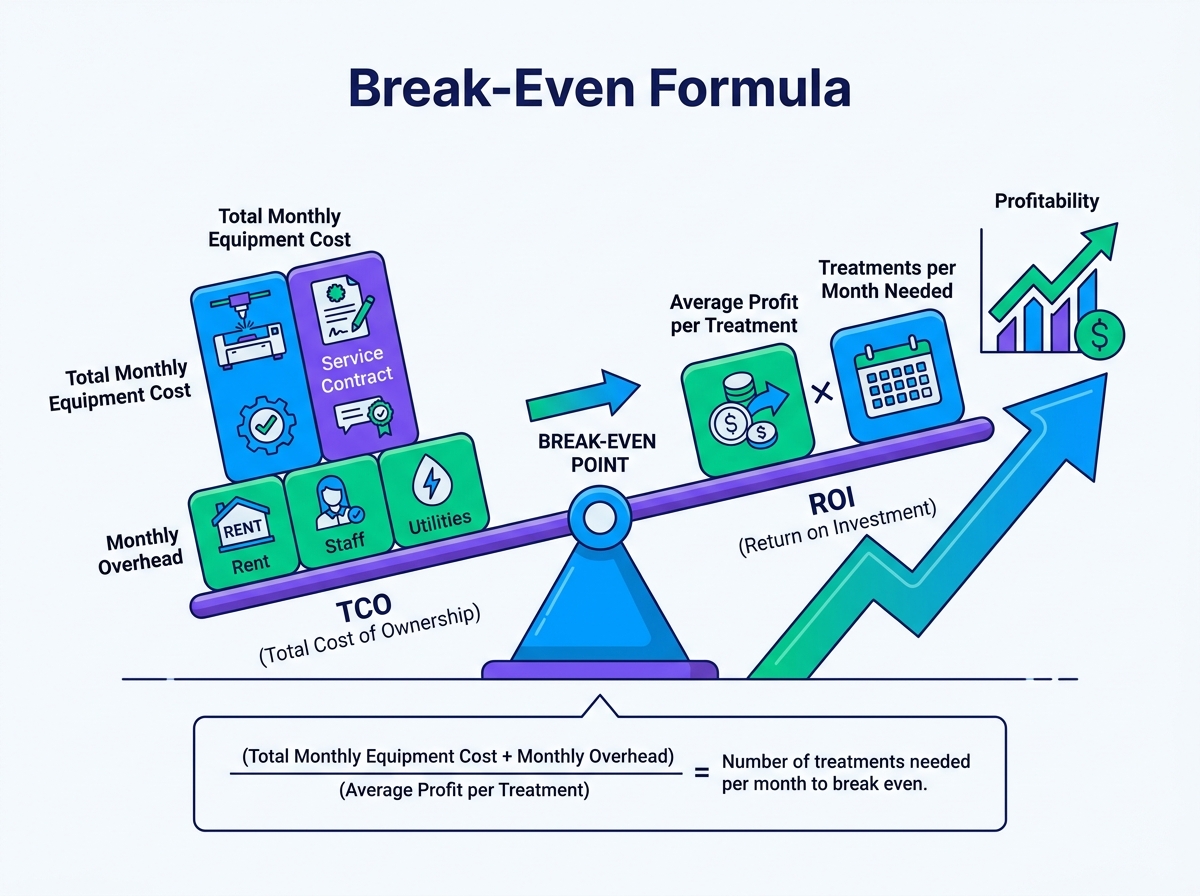
Calculating your exact payback period removes emotion from the purchasing process. The core mathematical equation remains straightforward for any medical device. First, add your total monthly equipment cost to your monthly overhead allocated to that room. Divide this sum by your average profit per treatment. The final result equals the exact number of treatments needed per month simply to break even.
Time-to-clearance variables heavily influence this formula in daily practice. Room setup and topical numbing take considerable time. Actual laser firing often lasts under five minutes for a medium-sized design. Room turnover requires additional staff effort and cleaning protocols. You must calculate the maximum theoretical treatments your clinic can perform per day. Then, compare this optimized number against realistic, market-driven booking realities.
Your chosen pricing strategy dictates cash flow survival. Per-session billing yields slower initial cash flow. It also carries a high patient drop-off risk after session three or four when fading slows down. Conversely, package deals secure upfront cash flow immediately. Offering third-party financing options locks in your returns early. Packages guarantee patient commitment to the entire clinical outcome.
Monthly Break-Even Calculation Matrix
Financial Metric | Per-Session Billing Model | Package Deal (Financed) Model |
|---|---|---|
Initial Cash Flow Velocity | Slow and incremental | Immediate and substantial |
Patient Attrition Risk | High (often drop out after 3 sessions) | Low (financially committed to the end) |
Administrative Burden | High (billing per visit) | Low (one-time financing approval) |
Revenue Predictability | Unpredictable monthly fluctuations | Highly predictable guaranteed income |
Downtime destroys clinic profitability faster than any other operational factor. Calculate the daily revenue lost if a machine sits broken for seventy-two hours. Add the reputational damage of canceling appointments on frustrated patients. This theoretical financial loss quickly justifies the premium price tag of a comprehensive maintenance contract. You must view maintenance as revenue insurance.
You must ruthlessly evaluate manufacturer service agreements. Proper laser equipment service and support dictates your long-term clinical success. Look for guaranteed technician response times. Demand immediate warehouse parts availability. Ask about complimentary loaner equipment policies during extended repairs. A cheap machine with poor support costs far more over five years than a premium machine with stellar backing.
Beware of common warranty traps hidden in the fine print. Baseline warranties often exclude accidental damage entirely. Dropping a delicate handpiece usually voids coverage instantly. User-error calibrations, blocked water cooling systems, and optical misalignments rarely fall under standard protection. Read the exclusions list carefully before assuming you have full coverage.
Use a strict shortlisting logic when interviewing sales reps. Rule out any manufacturer unable to provide local, factory-trained technicians. They must guarantee a forty-eight-hour repair window in writing. Anything slower risks devastating your weekly cash flow and infuriating your prepaid package clients.
Operational implementation involves strict regulatory compliance. Factor in local state and regional medical board regulations first. Determine if your device requires a medical doctor, a registered nurse, or a certified laser technician to fire the pedal. Calculate the hourly wage difference between these specific credentials carefully. Hiring an expensive medical director to oversee operations heavily impacts your break-even formula.
Adding Class IV medical devices impacts your medical malpractice insurance policy immediately. Consult your insurance broker early in the planning stage. Detail the exact premium increases required for your new operational scope. Uninsured or underinsured treatments expose your business to catastrophic financial ruin if adverse reactions occur.
Managing patient expectations prevents costly legal disputes. Overpromising clinical results carries immense financial risk. Emphasize highly conservative clinical consultations. Tell patients the absolute truth about stubborn ink colors, skin types, and potential ghosting. Honest communication prevents refund demands. It neutralizes negative online reviews. It also avoids messy legal disputes over incomplete clearance claims.
The final verdict requires a highly disciplined decision-making sequence. First, calculate all comprehensive lifecycle expenses thoroughly. Next, choose between nanosecond and picosecond technology based on your local market demographics and pricing power. Model your exact break-even formula using realistic booking volumes, not theoretical maximums. Finally, carefully vet the proposed maintenance contracts to protect against catastrophic downtime.
Take decisive action today. Audit your current patient base to gauge cross-sell potential for ink fading services. Request blinded operational expense data from at least three tier-one manufacturers. Review these financial numbers meticulously with your accountant before ever signing a final purchase order.
A: Buying new provides full warranties and the latest technology, minimizing downtime risks. Refurbished units drastically lower your initial capital expenditure but carry higher maintenance risks. If buying refurbished, ensure it includes a recertified service contract directly from the original manufacturer to protect against sudden repair bills.
A: A well-managed MedSpa typically breaks even on a picosecond device between eight to eighteen months. This timeline assumes an average volume of twenty to thirty patients per month using financed package deals. Clinics relying solely on per-session billing usually face a longer payback period.
A: Yes, you can confidently charge a premium. Do not just sell the technology name. Frame your pricing around selling faster clinical results and fewer overall sessions. Patients willingly pay more per visit when they understand they will endure less total discomfort and achieve clearance faster.
A: Clinics can utilize capital leases, traditional bank loans, or manufacturer-backed financing programs. Additionally, you should consult your tax advisor about Section 179 tax deductions. This code often allows clinics to deduct the full purchase price of qualifying equipment during the current tax year, improving early cash flow.


 Copyright © 2021 Shanghai Apolo Medical Technology Co., Ltd All Right Reserved. Sitemap Support By Leadong


